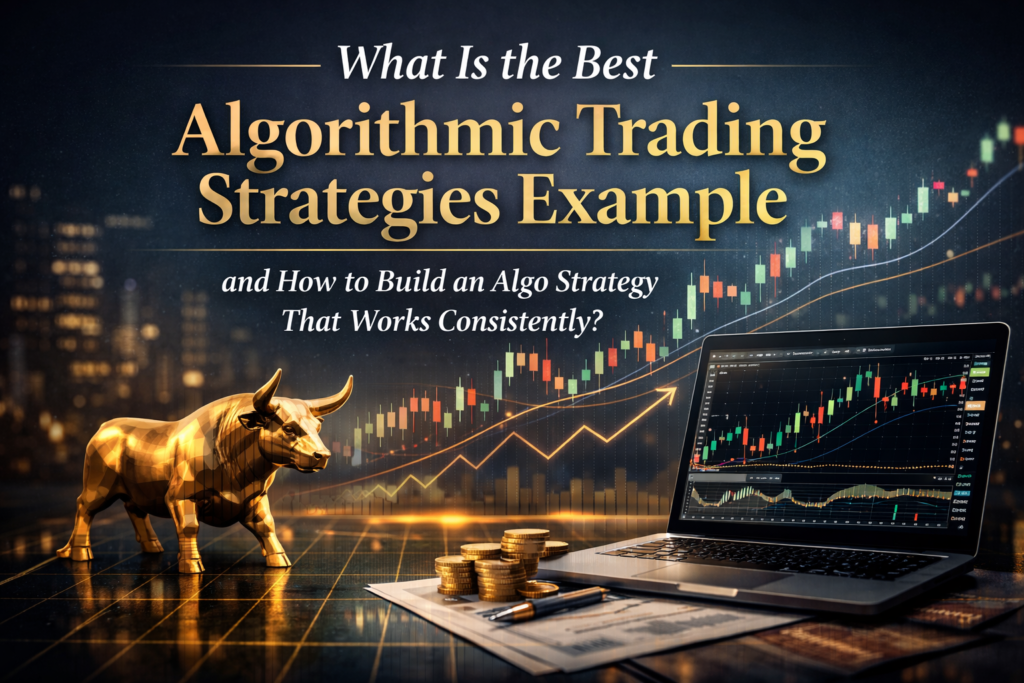

Algo trading strategies use data, automation, and predefined trading techniques to execute trades efficiently. From trend-following to arbitrage, these strategies reduce human error and improve speed. The best stock trading strategies combine analytics, risk management, and discipline, helping traders build consistent, scalable, and emotion-free trading systems in modern financial markets.
In today’s fast-moving financial markets, relying solely on intuition is no longer enough. The rise of algorithmic trading has transformed how traders approach the market. By combining data, automation, and advanced trading techniques, algo trading strategies allow traders to execute trades with precision, speed, and consistency.
This blog dives deep into algorithmic trading strategies, explores different trading strategies, and explains how modern traders use trading methodologies to stay ahead. Whether you’re a beginner or an experienced trader, understanding these concepts is crucial for long-term success.
What Are Algo Trading Strategies?
Algorithmic trading strategies are rule-based systems that automatically execute trades based on predefined conditions. These strategies rely on:
- Price movements
- Technical indicators
- Market trends
- Volume data
- Statistical models
Instead of manually placing trades, traders use algorithms to implement stock trading techniques that remove emotional bias and improve efficiency.
Why Algo Trading is the Future of Trading
Traditional trading methods often involve delays, emotional decisions, and inconsistencies. Algo trading eliminates these challenges.
Key Advantages:
- Speed: Executes trades in milliseconds
- Accuracy: Reduces human error
- Scalability: Handles multiple trades simultaneously
- Discipline: Follows predefined rules without deviation
These benefits make algo trading one of the most popular trading strategies in today’s financial ecosystem.
Core Trading Concepts Behind Algo Trading
Before diving into strategies, it’s essential to understand key trading concepts:
1. Market Trends
Understanding whether the market is bullish, bearish, or sideways is fundamental.
2. Liquidity
High liquidity ensures smoother trade execution with minimal slippage.
3. Volatility
Volatility determines how much price moves, influencing strategy selection.
4. Risk Management
No strategy works without proper risk control.
These foundational concepts form the backbone of all successful trading methods.
Types of Algo Trading Strategies
Let’s explore the most effective and widely used types of trading strategies in algorithmic trading.
1. Trend Following Strategies
Trend-following is one of the best stock trading strategies used by both beginners and professionals.
How it works:
- Buy when the market is trending upward
- Sell when the market is trending downward
Tools used:
- Moving Averages
- MACD
- RSI
Why it works:
Markets often move in trends, and this strategy captures those movements efficiently.
2. Mean Reversion Strategies
This strategy assumes that prices will revert to their average over time.
How it works:
- Buy when price is below average
- Sell when price is above average
Key Indicators:
- Bollinger Bands
- Standard Deviation
This is one of the most reliable stock market trading strategies for range-bound markets.
3. Arbitrage Strategies
Arbitrage exploits price differences across markets.
Example:
Buying a stock at a lower price on one exchange and selling it at a higher price on another.
Benefits:
- Low risk
- High frequency
This is among the most advanced trading methodologies used by institutional traders.
4. Momentum-Based Strategies
Momentum trading focuses on stocks that are moving strongly in one direction.
Approach:
- Identify high momentum stocks
- Ride the trend until it weakens
Why it works:
Momentum often attracts more traders, pushing prices further.
These are widely used in day trade strategies.
5. Statistical Arbitrage
This strategy uses mathematical models and correlations.
How it works:
- Identify correlated assets
- Trade based on deviations
Example:
If two stocks usually move together and diverge, traders bet on convergence.
A powerful method among top stock trading strategies.
6. Market Making Strategies
Market makers provide liquidity by placing buy and sell orders simultaneously.
Profit Source:
- Bid-ask spread
Risk:
- Sudden price movements
This is a sophisticated trading strategy used by institutions.
7. High-Frequency Trading (HFT)
HFT involves executing thousands of trades in milliseconds.
Key Features:
- Ultra-fast execution
- Advanced algorithms
- Co-location servers
This represents the cutting edge of stock trading strategies.
Best Trading Strategy for Different Traders
Not all strategies suit everyone. Choosing the right one depends on your goals, risk tolerance, and capital.
| Trader Type | Best Strategy |
|---|---|
| Beginner | Trend Following |
| Intermediate | Mean Reversion |
| Advanced | Statistical Arbitrage |
| Intraday Trader | Momentum & Day Trade Strategies |
| Long-Term Trader | Hybrid Strategies |
Understanding your profile helps you pick the most effective trading techniques.
Trading Strategies for Day Trading
Day trading requires fast decision-making and quick execution.
Popular Day Trading Strategies:
- Scalping
- Breakout Trading
- Momentum Trading
- VWAP Strategy
These are among the most effective trading strategies for day trading.
Stock Trading Techniques Used in Algo Trading
Modern algo trading integrates multiple stock trading techniques:
1. Technical Analysis
Using indicators and charts to predict price movements.
2. Quantitative Analysis
Applying mathematical models to identify patterns.
3. Machine Learning
Using AI to improve strategy accuracy over time.
4. Backtesting
Testing strategies on historical data before live trading.
These techniques define the evolution of trading methods in the digital age.
Risk Management in Algo Trading
Even the best strategies fail without proper risk management.
Key Principles:
- Use stop-loss orders
- Limit position size
- Diversify strategies
- Avoid over-leveraging
Risk management separates successful traders from unsuccessful ones.
How to Build a Successful Trading Strategy
Creating a profitable algo trading system involves multiple steps:
Step 1: Define Your Objective
Are you trading for income or long-term growth?
Step 2: Choose a Strategy
Select from different trading strategies based on your style.
Step 3: Develop Rules
Clearly define entry and exit conditions.
Step 4: Backtest
Validate your strategy using historical data.
Step 5: Optimize
Improve performance using data insights.
Step 6: Deploy & Monitor
Run your algorithm and track performance continuously.
Common Mistakes in Algo Trading
Avoid these pitfalls:
- Over-optimization
- Ignoring market conditions
- Poor risk management
- Emotional interference
- Lack of testing
Even advanced traders can fail if they ignore these factors.
The Future of Algo Trading Strategies
Algo trading is rapidly evolving with advancements in:
- Artificial Intelligence
- Big Data Analytics
- Cloud Computing
- Blockchain Integration
Future trading strategies will be more adaptive, predictive, and automated.
Final Thoughts
Algo trading strategies are not just tools—they are systems built on logic, discipline, and data. The most successful trading methods combine strong fundamentals with advanced analytics.
Whether you’re exploring share trading strategies or building automated systems, mastering these techniques will give you a competitive edge in the market.
Consistency, not complexity, is the key to success.
FAQ Section
1. What is the best trading strategy for beginners?
Trend-following strategies are the best starting point due to their simplicity and effectiveness.
2. Are algo trading strategies profitable?
Yes, when combined with proper risk management and backtesting, algo trading can be highly profitable.
3. What are the most popular trading strategies?
Trend following, momentum trading, mean reversion, and arbitrage are among the most popular trading strategies.
4. Can I use algo trading for day trading?
Absolutely. Many day trade strategies are automated using algorithms for faster execution.
5. What skills are required for algo trading?
You need knowledge of markets, programming, data analysis, and trading concepts.
6. How do I choose the right trading methodology?
Select based on your risk tolerance, capital, and trading goals.
7. Is algo trading suitable for small investors?
Yes, with the availability of platforms and tools, even retail traders can use algo trading effectively.
8. What is the biggest risk in algo trading?
Poor risk management and over-optimization are the biggest risks.