

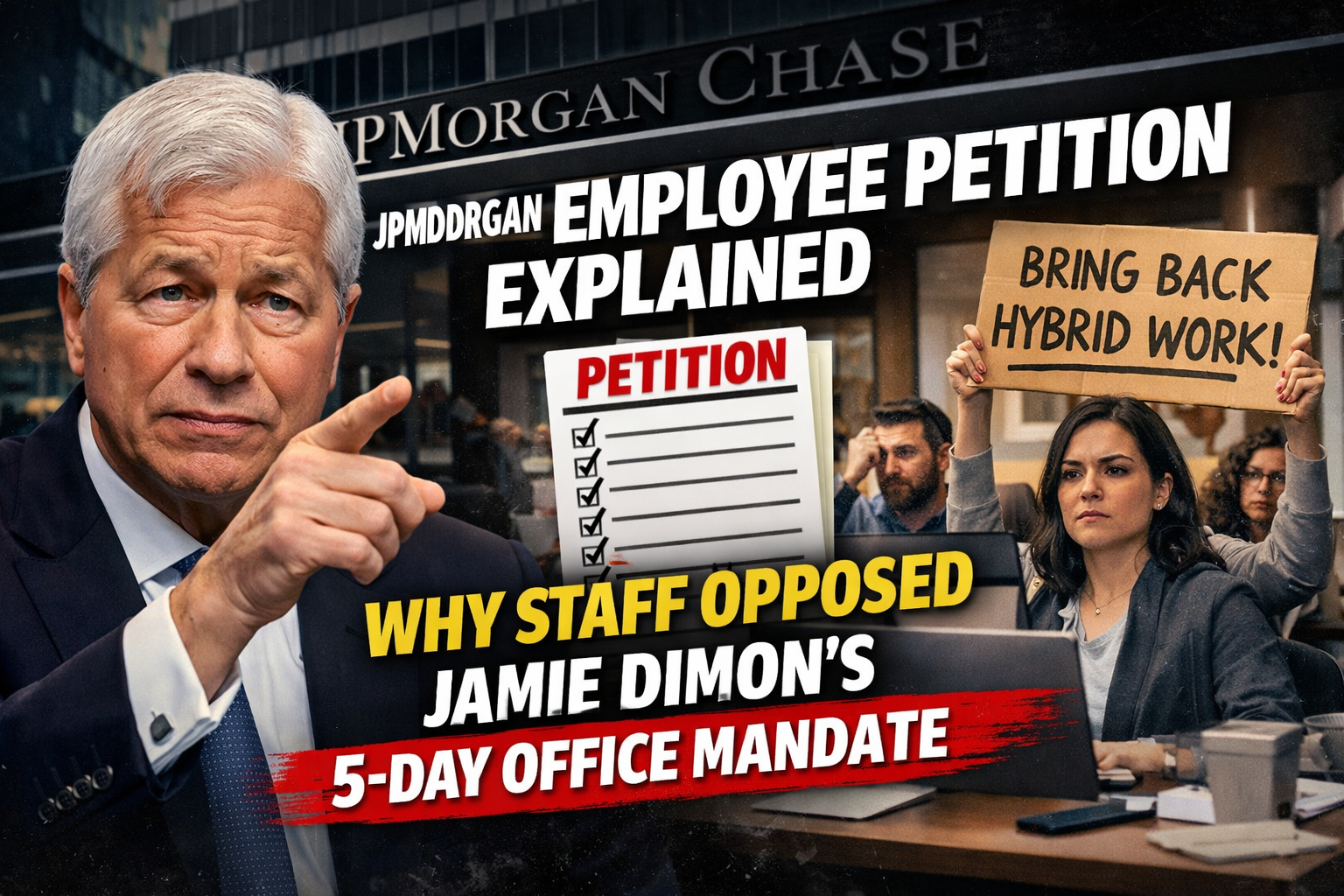
The JPMorgan employee petition emerged after CEO Jamie Dimon mandated a full five-day return to office, ending hybrid work. About 2,000 employees signed, citing work-life balance, long commutes, and flexibility concerns. Leadership rejected the petition, reinforcing the bank’s in-office culture stance.
Introduction: Why the JPMorgan Employee Petition Matters
In early 2025, JPMorgan Chase found itself at the center of a global workplace debate after announcing a strict return-to-office policy. CEO Jamie Dimon directed employees to work from the office five days a week, officially ending the hybrid work model that many had adopted since the COVID-19 pandemic.
The announcement triggered internal dissatisfaction and led to an employee-led petition requesting reconsideration of the mandate. While the petition did not result in policy changes, it exposed deeper tensions around employee autonomy, workplace flexibility, leadership authority, and the future of work in large corporations.
This blog explores the JPMorgan employee petition in detail, including why it started, what employees demanded, how leadership responded, and what it means for the banking industry and corporate work culture worldwide.
Background: JPMorgan’s Return-to-Office Mandate
End of Hybrid Work at JPMorgan
In January 2025, JPMorgan Chase informed employees that hybrid working arrangements would be discontinued for most roles. Staff were required to return to the office five days a week starting March 2025.
During the pandemic, JPMorgan—like many global firms—had allowed remote and hybrid work to ensure continuity and safety. Over time, employees grew accustomed to flexible schedules that reduced commuting time and improved work-life balance.
Jamie Dimon, however, maintained that remote work diluted productivity, collaboration, and learning, especially for younger employees. According to leadership, physical presence was essential to maintaining JPMorgan’s performance, culture, and client service standards.
What Is the JPMorgan Employee Petition?
Origin of the Petition
The petition originated internally among employees dissatisfied with the removal of hybrid work. It was later shared more widely, gaining attention from international media.
Key Demands and Concerns
The petition did not call for permanent remote work. Instead, it focused on flexibility. Key concerns included:
- Restoration of hybrid work options rather than mandatory full-time office attendance
- Impact on work-life balance, particularly for parents and caregivers
- Long commuting times increasing stress and reducing productivity
- Global teams operating across time zones where physical presence offers limited value
- Risk of losing skilled talent to more flexible employers
Employees emphasized that productivity had not declined under hybrid models and argued that performance should be measured by outcomes rather than physical attendance.
How Many Employees Signed the Petition?
Approximately 2,000 employees signed the petition. While that number appears significant, it represents less than one percent of JPMorgan Chase’s global workforce of over 300,000 employees.
The relatively low participation rate is often attributed to employee fear rather than lack of concern.
“Career Suicide”: Why Many Employees Stayed Silent
One of the most striking revelations surrounding the petition was employee fear. Multiple reports suggested that workers viewed openly opposing leadership as risky.
Many employees described signing the petition as “career suicide,” worrying about:
- Being labeled uncommitted or disloyal
- Missed promotions or bonuses
- Negative performance evaluations
- Reduced visibility or future leadership opportunities
This fear highlights the power imbalance in large corporate environments, particularly in high-pressure sectors like banking.
Jamie Dimon’s Response to the Petition
Jamie Dimon publicly dismissed the petition during an internal town hall meeting. According to reports, he expressed frustration and made it clear that the decision would not be reversed.
He reiterated several core beliefs:
- In-person work improves collaboration and innovation
- Young employees benefit more from direct mentorship
- Remote work weakens culture and accountability
- Employees unhappy with the policy are free to seek opportunities elsewhere
Dimon’s response reinforced his long-standing opposition to remote work and sent a clear message that leadership would not negotiate on the issue.
Why JPMorgan Supports a Full Return to Office
Collaboration and Training
JPMorgan leadership argues that spontaneous conversations, mentoring, and team problem-solving happen more effectively in person. Executives believe junior staff learn faster when physically present.
Corporate Culture
The bank places high value on culture, discipline, and structured environments. Leadership views office presence as essential to maintaining these standards.
Real Estate Investments
JPMorgan has invested billions in office infrastructure, including its flagship global headquarters at 270 Park Avenue in New York. Leadership believes these spaces are central to long-term growth and collaboration.
Industry Context: JPMorgan Is Not Alone
JPMorgan is part of a broader trend among financial institutions pushing employees back to offices. Banks such as Goldman Sachs and other Wall Street firms have also adopted strict return-to-office policies.
However, this contrasts sharply with sectors like technology, consulting, and startups, where hybrid and remote work are increasingly viewed as permanent benefits.
This divide highlights a growing philosophical split between traditional corporate models and modern workplace expectations.
Impact on Employees and Talent Retention
Employee Morale
The mandate and dismissal of employee concerns reportedly affected morale, particularly among mid-level and senior professionals who had built routines around hybrid work.
Talent Risk
Critics argue that rigid office policies may push skilled workers toward competitors offering flexibility. Younger professionals, in particular, increasingly prioritize work-life balance when choosing employers.
Unionization Discussions
The controversy also sparked early conversations around unionization—an uncommon topic in U.S. banking. While no formal union efforts materialized, the discussions alone signal rising employee frustration and desire for collective representation.
What Happens Next?
Short-Term Outlook
JPMorgan is unlikely to reverse its policy in the near future. Leadership remains firm, and the petition has not altered official strategy.
Long-Term Implications
- Other banks may adopt similar policies after observing JPMorgan
- Employees may gradually accept office mandates or seek alternative employers
- Companies may refine hybrid policies to avoid backlash
The situation will likely influence how corporations balance control with flexibility in the years ahead.
Why the JPMorgan Employee Petition Is Important
Even though the petition did not succeed, it represents a critical moment in post-pandemic workplace history. It reflects:
- Changing employee expectations
- Growing emphasis on flexibility and autonomy
- Tension between traditional leadership styles and modern workforce values
- The evolving definition of productivity
The JPMorgan employee petition is less about one bank and more about a global shift in how people want to work.
Final Thoughts
The JPMorgan employee petition shows that the future of work remains unresolved. While leadership prioritizes structure and control, employees increasingly value flexibility and trust.
As more companies face similar decisions, this case will continue to be referenced as a defining example of how corporate power and employee voice collide in the modern workplace.