
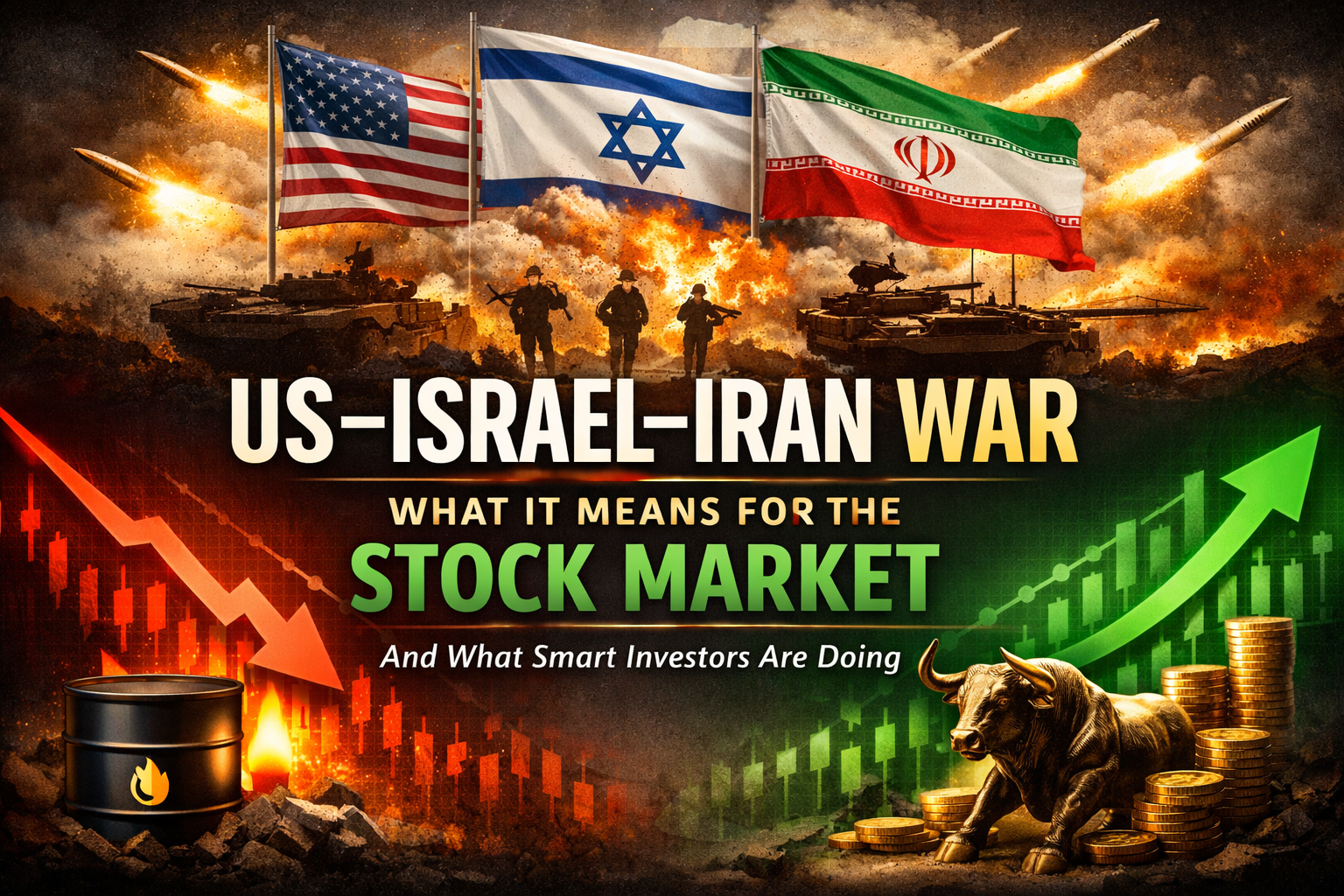
- The ongoing US–Israel–Iran conflict has triggered sharp volatility across global stock markets
- Oil prices remain the biggest driver, influencing inflation, interest rates, and investor sentiment
- Markets typically fall during escalation and recover quickly after signs of stability or ceasefire
- Key sectors react differently: energy rises during conflict, while airlines, FMCG, and tech suffer
- The Indian stock market is highly sensitive due to heavy dependence on imported oil
- Smart investors focus on sector rotation, timing, and macro signals rather than panic
Introduction
Geopolitical conflicts have always played a powerful role in shaping global financial markets. The recent US–Israel–Iran war is no exception. As tensions escalated in the Middle East, markets across the world reacted instantly—falling sharply during uncertainty and rebounding just as quickly with signs of de-escalation.
However, this is not just a short-term reaction. This conflict has deeper implications for oil prices, inflation, investor psychology, and long-term economic stability.
In this blog, we will break down exactly how and why this war impacts the stock market, what sectors are affected, and what investors should actually do in such situations.
How War Impacts the Stock Market
The Core Mechanism: Uncertainty + Oil Shock
At its core, the stock market reacts to two things during war:
- Uncertainty
- Resource disruption (especially oil)
The Middle East is critical because it controls a significant portion of global oil supply. When conflict threatens key routes like the Strait of Hormuz, supply fears drive oil prices higher.
Why This Matters
- Higher oil prices → Higher inflation
- Higher inflation → Central banks tighten policies
- Higher interest rates → Lower stock valuations
Therefore, a war doesn’t just affect one sector—it triggers a chain reaction across the entire economy.
Oil Prices: The Real Market Driver
Why Oil Controls the Market Direction
Oil is not just another commodity—it is the backbone of global economic activity.
- Transportation depends on it
- Manufacturing depends on it
- Supply chains depend on it
When oil prices spike:
- Business costs rise
- Profit margins shrink
- Consumer spending drops
As a result, stock markets decline.
What Happened in This Conflict
During the escalation phase:
- Oil prices surged due to supply fears
After ceasefire signals:
- Oil prices dropped sharply
- Markets rebounded globally
This shows a critical pattern:
👉 Markets react more to economic impact than to the war itself
Sector-Wise Impact of the War
1. Energy Sector (Oil & Gas)
Impact:
- Gains during conflict
- Falls after stability returns
Why:
Energy companies benefit directly from higher oil prices.
2. Aviation & Travel Sector
Impact:
- Sharp decline during war
- Strong recovery after oil prices fall
Why:
Fuel is the largest cost component for airlines.
3. FMCG & Manufacturing
Impact:
- Margins shrink during conflict
- Gradual recovery after stabilization
Why:
Higher transportation and raw material costs reduce profitability.
4. Technology Stocks
Impact:
- Fall during uncertainty
- Recover with market confidence
Why:
Tech stocks are considered high-risk assets during volatile periods.
5. Defense Sector (Hidden Winner)
Impact:
- Strong gains
Why:
War increases defense spending and government contracts.
Global Market Reaction
When the conflict escalated:
- Markets across the US, Europe, and Asia declined
- Investors moved toward safe assets
When ceasefire signals emerged:
- Markets rallied sharply
- Risk appetite returned
This highlights a powerful truth:
👉 Markets hate uncertainty more than bad news itself
Impact on the Indian Stock Market
India is particularly vulnerable to Middle East conflicts.
Why India is Highly Affected
- Imports ~85% of its crude oil
- Relies heavily on Gulf countries
- Sensitive to currency fluctuations
During War Escalation
- Nifty and Sensex decline
- Rupee weakens
- Inflation concerns rise
After Stability Returns
- Markets rebound
- Oil-dependent sectors recover
- Investor confidence improves
The Psychology Behind Market Movements
Risk-Off vs Risk-On Behavior
During war:
- Investors shift to gold, bonds, and cash
- Equity markets see selling pressure
After stability:
- Investors move back into stocks
- Markets rally quickly
The Role of Fear and Liquidity
Stock markets are not just driven by data—they are driven by emotion.
- Fear → Panic selling
- Relief → Aggressive buying
This is why markets often move sharply in both directions.
Advanced Insight: The Real Opportunity
Most investors lose money during such events because they react emotionally.
However, smart investors understand:
1. Volatility Creates Opportunity
Market dips during war are often temporary.
2. Sector Rotation is Key
Money shifts from one sector to another—not out of the market entirely.
3. Timing Matters More Than News
By the time news is public, markets have already reacted.
What Should Investors Do?
1. Avoid Panic Selling
Short-term volatility is normal during geopolitical events.
2. Watch Oil Prices Closely
Oil is the leading indicator for market direction.
3. Focus on Strong Sectors
- Defense
- Energy (short term)
- Consumption (long-term recovery)
4. Use Corrections to Accumulate
Quality stocks at lower prices create long-term wealth.
My Perspective (Expert Insight)
This conflict reinforces one important principle:
👉 The stock market is not driven by events—it is driven by expectations.
War creates fear.
Fear creates volatility.
Volatility creates opportunity.
The investors who win are not the ones who predict the war, but the ones who understand the reaction.
Conclusion
The US–Israel–Iran war is a classic example of how geopolitical tensions influence financial markets. While the immediate impact is often negative due to uncertainty and rising oil prices, markets tend to recover quickly once stability returns.
For investors, the key is not to react emotionally but to understand the underlying economic mechanisms. Oil prices, inflation, and investor sentiment play a much larger role than the conflict itself.
Ultimately, those who stay disciplined, focus on data, and act strategically are the ones who benefit the most from such situations.
FAQ Section
Because of uncertainty, rising oil prices, and fear among investors, which leads to selling pressure.
Energy and defense sectors typically benefit due to increased demand and higher prices.
Because uncertainty reduces, oil prices stabilize, and investor confidence returns.
India is heavily dependent on oil imports, so rising oil prices increase inflation and negatively impact the market.
Yes, if approached strategically. Market dips often create strong long-term investment opportunities.
Oil prices
Inflation data
Interest rate expectations
Global market sentiment