
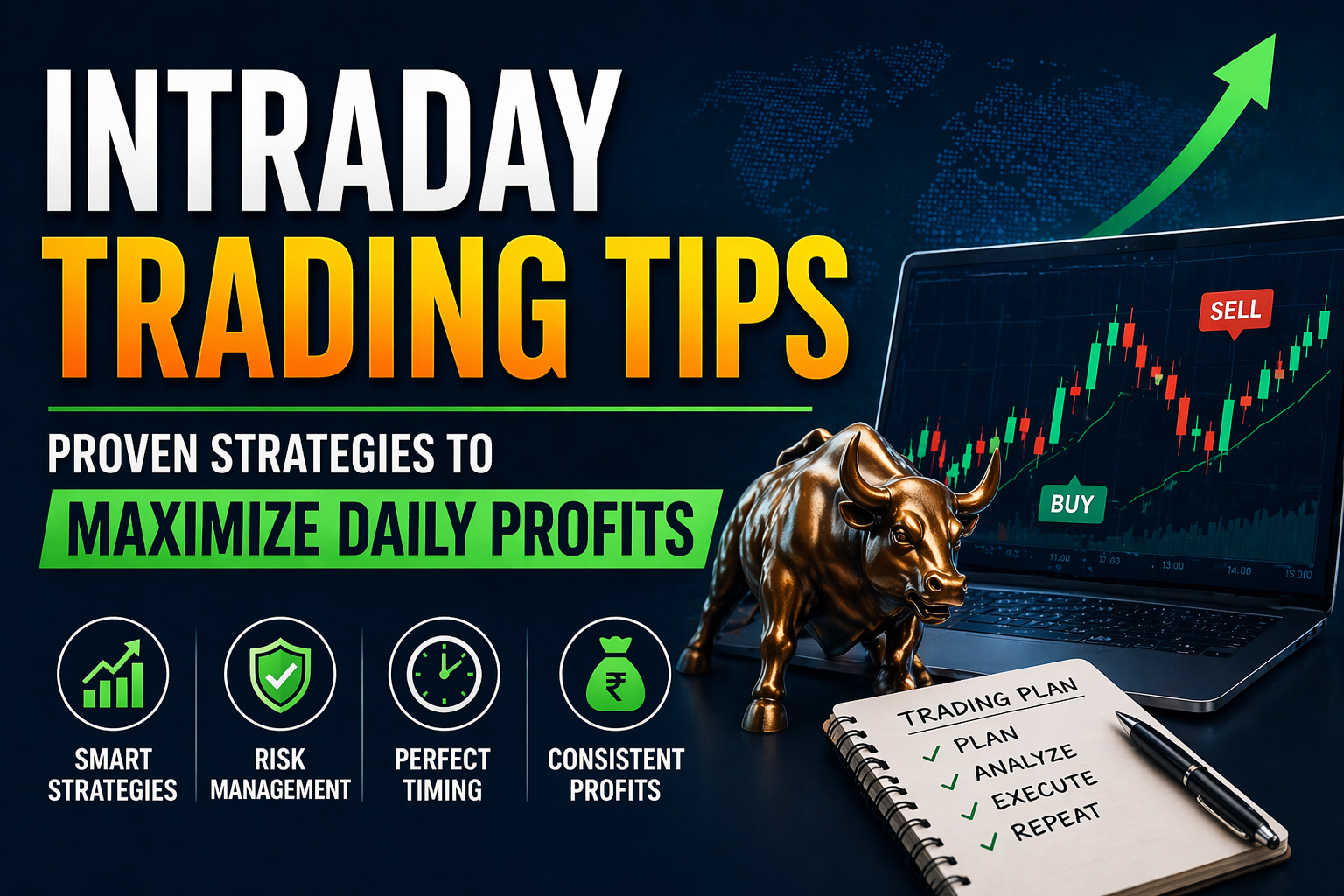
The most effective intraday trading tips focus on disciplined execution, strict risk management, and a clear strategy such as momentum trading or breakout trading. Successful traders limit losses with stop-loss orders, trade high-volume stocks, follow a predefined plan, and avoid emotional decisions—ensuring consistency over quick wins.
INTRODUCTION
Intraday trading can be highly rewarding—but only if approached with precision, discipline, and the right strategy. Many beginners enter the market expecting quick profits, only to face losses due to poor planning and emotional decision-making.
That’s where the right intraday trading tips come in. Whether you’re just starting out or refining your approach, understanding proven methods, risk control techniques, and execution timing can dramatically improve your results.
In this guide, you’ll learn actionable insights, the best intraday trading strategy, and real-world techniques that professional traders use daily.
SEARCH INTENT: INFORMATIONAL
This article is designed to provide educational and actionable insights for traders looking to improve their intraday trading performance.
What is Intraday Trading?
Definition (Featured Snippet Optimized):
Intraday trading refers to buying and selling financial instruments such as stocks within the same trading day, with all positions squared off before the market closes. The goal is to capitalize on short-term price movements using technical analysis, volume indicators, and precise timing.
Why Intraday Trading Requires a Strategy
Without a structured plan, intraday trading becomes gambling. Markets move quickly, and decisions must be backed by logic—not emotion.
A well-defined best intraday trading strategy helps you:
- Identify entry and exit points
- Minimize losses
- Maintain consistency
- Avoid impulsive trades
Best Intraday Trading Strategy for Consistent Results
1. Momentum Trading Strategy
This strategy focuses on stocks moving strongly in one direction with high volume.
How it works:
- Identify stocks with high news impact or unusual volume
- Enter when price confirms momentum
- Exit before momentum weakens
Example:
A stock breaks resistance with strong volume at 10:30 AM. Traders enter early in the trend and exit near peak momentum.
2. Breakout Trading Strategy
One of the most popular intraday trading tips is trading breakouts.
Key idea:
Buy when price breaks above resistance or sell when it breaks below support.
Why it works:
- Breakouts indicate strong buying or selling pressure
- Often followed by sharp price moves
3. Scalping Strategy
This involves making multiple small profits throughout the day.
Key characteristics:
- Very short holding periods (minutes)
- High trade frequency
- Requires strict discipline
4. Reversal Trading Strategy
Here, traders identify when a trend is about to reverse.
However, this is riskier and requires experience with indicators like RSI and MACD.
Step-by-Step Intraday Trading Process
Time needed: 1 hour and 30 minutes
Follow a structured intraday process: select liquid stocks, analyze trends, plan entries, use stop-loss, and exit smartly. Stay disciplined, avoid overtrading, follow trends, and stick to one consistent strategy.
- Step 1: Select Liquid Stocks
Choose stocks with high volume and volatility.
- Step 2: Analyze the Trend
Use indicators like moving averages to determine direction.
- Step 3: Identify Entry Points
Look for breakouts, pullbacks, or momentum signals.
- Step 4: Set Stop Loss
Always define your risk before entering a trade.
- Step 5: Execute the Trade
Follow your plan strictly—no emotional decisions.
- Step 6: Book Profits or Exit
Exit at predefined targets or if the trade goes against you.
Top Intraday Trading Tips Every Trader Must Follow
1. Always Use Stop Loss
This is the most critical rule. Even the best traders lose money—what matters is controlling losses.
2. Trade Only 2–3 Stocks
Overtrading leads to confusion and mistakes. Focus increases accuracy.
3. Avoid Trading in the First 15 Minutes
Markets are highly volatile at opening. Wait for direction to form.
4. Follow Market Trends
“Trend is your friend” is especially true in intraday trading.
5. Don’t Chase Trades
If you miss an entry, let it go. Chasing leads to poor decisions.
6. Stick to One Strategy
Switching strategies frequently reduces consistency.
Comparison: Intraday Trading vs Swing Trading (Featured Snippet Section)
| Factor | Intraday Trading | Swing Trading |
|---|---|---|
| Duration | Same day | Days to weeks |
| Risk Level | High | Moderate |
| Time Required | Full-time monitoring | Less time |
| Profit Potential | Quick but small | Slower but larger |
Conclusion:
Intraday trading suits traders who can actively monitor markets, while swing trading is better for those with limited time.
Real-World Example of Intraday Trading
Let’s say a stock opens at ₹500 and shows strong buying volume due to positive news.
- Resistance at ₹510 breaks
- Trader enters at ₹512
- Stop loss at ₹505
- Target at ₹530
Within 2 hours, the stock hits ₹528, and the trader exits with a solid profit.
Key takeaway:
This trade works because of discipline, planning, and execution—not luck.
Common Mistakes to Avoid
Even with the best intraday trading tips, traders fail due to these errors:
- Overtrading
- Ignoring stop-loss
- Emotional trading
- Lack of strategy
- Trading based on tips or rumors
Therefore, avoiding these mistakes is as important as learning strategies.
Risk Management: The Backbone of Intraday Trading
Professional traders focus more on risk than profit.
Key Rules:
- Never risk more than 1–2% of capital per trade
- Maintain a risk-reward ratio of at least 1:2
- Diversify trades across sectors
Moreover, consistency in risk management leads to long-term profitability.
Tools Every Intraday Trader Should Use
- Charting platforms (TradingView, Zerodha Kite)
- Indicators (RSI, MACD, VWAP)
- Volume analysis tools
- News tracking platforms
Internal Linking Opportunities
- Beginner’s Guide to Stock Market Trading
- Technical Analysis Basics for Traders
- Risk Management Strategies in Trading
- How to Read Candlestick Charts
- Best Indicators for Day Trading
External References (Suggested)
- Investopedia – Intraday Trading Basics
- NSE India – Market Data and Insights
- SEBI Guidelines on Trading Practices
FAQ Section
Momentum and breakout strategies are widely considered the most effective due to their alignment with market movement.
You can start with a small amount, but having adequate capital helps manage risk better.
Yes, but they must start with proper education, practice, and strict risk management.
Always use a stop-loss to limit losses.
It can be profitable with discipline, strategy, and experience.
Ideally 1–3 high-quality trades are sufficient.
Mid-session (10:30 AM – 1:30 PM) is generally more stable
CONCLUSION
Mastering intraday trading tips is not about finding a magic formula—it’s about consistency, discipline, and execution. The most successful traders rely on structured strategies like momentum and breakout trading while strictly managing risk.
If you focus on quality trades, avoid emotional decisions, and continuously refine your approach, intraday trading can become a powerful source of income.