
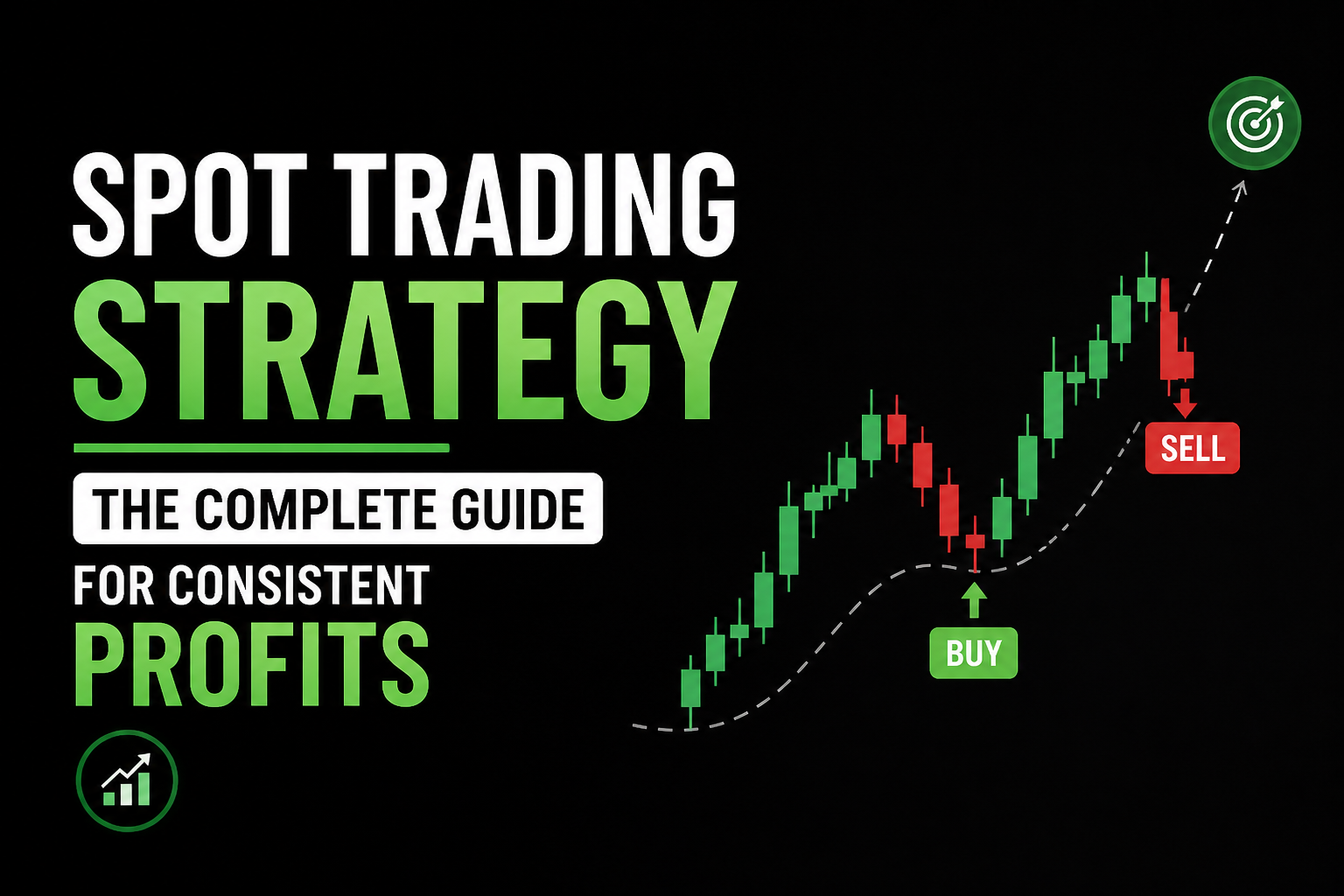
A spot trading strategy involves buying and selling assets (like stocks, crypto, or commodities) for immediate delivery at current market prices. Traders profit by identifying trends, support/resistance levels, and timing entries and exits effectively—without leverage or complex derivatives.
INTRODUCTION
A well-executed spot trading strategy is one of the most reliable ways to build consistency in trading. Unlike derivatives or leveraged trading, spot trading focuses on simplicity—you buy an asset, you own it, and you sell it when the price increases.
However, simplicity does not mean easy. Many spot traders struggle because they lack a structured approach. Without strategy, discipline, and market understanding, even the most straightforward trading style can lead to losses.
Therefore, in this guide, you will learn exactly what is a spot trade, how to build a profitable spot trading strategy, and how to apply it in real-world market conditions.
SEARCH INTENT: INFORMATIONAL
This content is designed to educate readers about spot trading strategies, how they work, and how to implement them effectively.
What Is a Spot Trade?
Definition (Featured Snippet Ready)
A spot trade is a financial transaction where an asset is bought or sold for immediate delivery at the current market price. In spot trading, ownership of the asset is transferred instantly, and there is no use of leverage or future contracts, making it simpler and less complex than derivatives trading.
Understanding Spot Trading Strategy
A spot trading strategy focuses on capitalizing on price movements by directly buying and selling assets.
Key Characteristics:
- Immediate settlement
- No leverage involved
- Lower risk compared to derivatives
- Full ownership of assets
Why Traders Prefer Spot Trading:
- Simplicity and transparency
- Reduced risk of liquidation
- Suitable for beginners and long-term investors
Step-by-Step: How to Build a Spot Trading Strategy
Step 1: Choose the Right Market
Focus on:
- Stocks
- Cryptocurrencies
- Commodities
Step 2: Identify Market Trend
Use:
- Moving averages
- Trendlines
- Price action
Step 3: Find Entry Points
Look for:
- Support levels
- Breakouts
- Pullbacks
Step 4: Set Exit Strategy
- Define profit targets
- Use stop-loss levels
Step 5: Manage Risk
- Risk only 1–2% of capital per trade
- Diversify your portfolio
Step 6: Track and Improve
- Maintain a trading journal
- Analyze past trades
Spot Trading Strategy vs Derivatives Trading
Comparison (Featured Snippet Section)
| Factor | Spot Trading Strategy | Derivatives Trading |
|---|---|---|
| Ownership | Yes | No |
| Risk Level | Lower | Higher |
| Leverage | No | Yes |
| Complexity | Low | High |
| Profit Potential | Moderate | High |
Key Insight:
A spot trading strategy is ideal for traders who prioritize stability and long-term growth over high-risk, high-reward trades.
Types of Spot Trading Strategies
1. Trend Following Strategy
- Buy in uptrends
- Sell in downtrends
2. Breakout Strategy
- Enter when price breaks key resistance
- Strong momentum-based trades
3. Range Trading Strategy
- Buy at support
- Sell at resistance
4. Scalping (Spot Trading)
- Capture small price movements
- High-frequency trades
Real-World Example: Spot Trading in Action
A trader uses a spot trading strategy on a cryptocurrency:
- Asset: ETH
- Entry: $1,800 (support level)
- Exit: $2,000 (resistance level)
Result:
- Profit: $200 per unit
This demonstrates how spot traders can generate consistent returns without leverage by focusing on price structure.
Key Indicators for Spot Trading Strategy
1. Moving Averages
- Identify trend direction
2. RSI (Relative Strength Index)
- Detect overbought/oversold conditions
3. Volume
- Confirms strength of price movement
4. Support and Resistance
- Key levels for entry and exit
Common Mistakes Spot Traders Make
Avoid these pitfalls:
- Trading without a strategy
- Ignoring stop-loss
- Overtrading
- Emotional decision-making
Advanced Insights for Spot Traders
1. Market Structure Awareness
Understanding higher highs and lower lows helps identify trends.
2. Liquidity Zones
Institutions often place large orders near key levels.
3. Multi-Timeframe Analysis
Analyze:
- Higher timeframe for trend
- Lower timeframe for entry
Internal Linking Opportunities
- Beginner’s guide to stock market trading
- Technical analysis fundamentals
- Risk management strategies in trading
- Intraday vs swing trading guide
External Authoritative References
- Investopedia (spot trading basics)
- NSE India (stock market insights)
- CoinMarketCap (crypto price data)
FAQ Section
1. What is a spot trade in simple terms?
It is buying or selling an asset instantly at the current market price.
2. Is spot trading safe?
Yes, compared to leveraged trading, it carries lower risk.
3. Can beginners use a spot trading strategy?
Yes, it is one of the best starting points for new traders.
4. How do spot traders make money?
By buying low and selling high based on market trends.
5. What markets support spot trading?
Stocks, cryptocurrencies, forex, and commodities.
6. Do I need large capital for spot trading?
No, you can start small and scale gradually.
7. Is spot trading profitable long term?
Yes, with discipline and a structured strategy.
CONCLUSION
A well-defined spot trading strategy provides a strong foundation for anyone entering the financial markets. It removes the complexity of leverage and focuses on pure price action, making it ideal for both beginners and experienced traders.
However, success in spot trading strategy execution requires discipline, consistency, and continuous learning. By understanding what is a spot trade, applying structured methods, and avoiding common mistakes, traders can build sustainable profitability over time.