
Option trading is a financial strategy where traders buy or sell contracts that give them the right (but not the obligation) to purchase or sell an asset at a specific price before a set date. By using strategies like buying calls, selling puts, or spreads, traders can profit from price movements, volatility, or time decay.
INTRODUCTION
Option trading has rapidly evolved from a niche strategy used by institutions into a powerful tool accessible to retail traders. Whether you want to hedge risk, generate income, or amplify returns, options offer flexibility that traditional stock trading simply cannot match.
However, many beginners either overcomplicate it or underestimate its risks. Therefore, understanding how options share trading, stock and options trading, and structured strategies work is essential before entering the market.
In this guide, you will learn how option trading works, how to build strategies, and how to trade stocks and options with confidence and discipline.
SEARCH INTENT: INFORMATIONAL
This content is designed to educate readers on option trading fundamentals, strategies, and real-world applications.
What Is Option Trading?
Definition (Featured Snippet Ready)
Option trading involves buying or selling derivative contracts that give traders the right, but not the obligation, to buy or sell an underlying asset at a predetermined price before a specified expiration date. It allows traders to profit from price movement, volatility, or time decay using strategic positions.
Types of Options in Option Trading
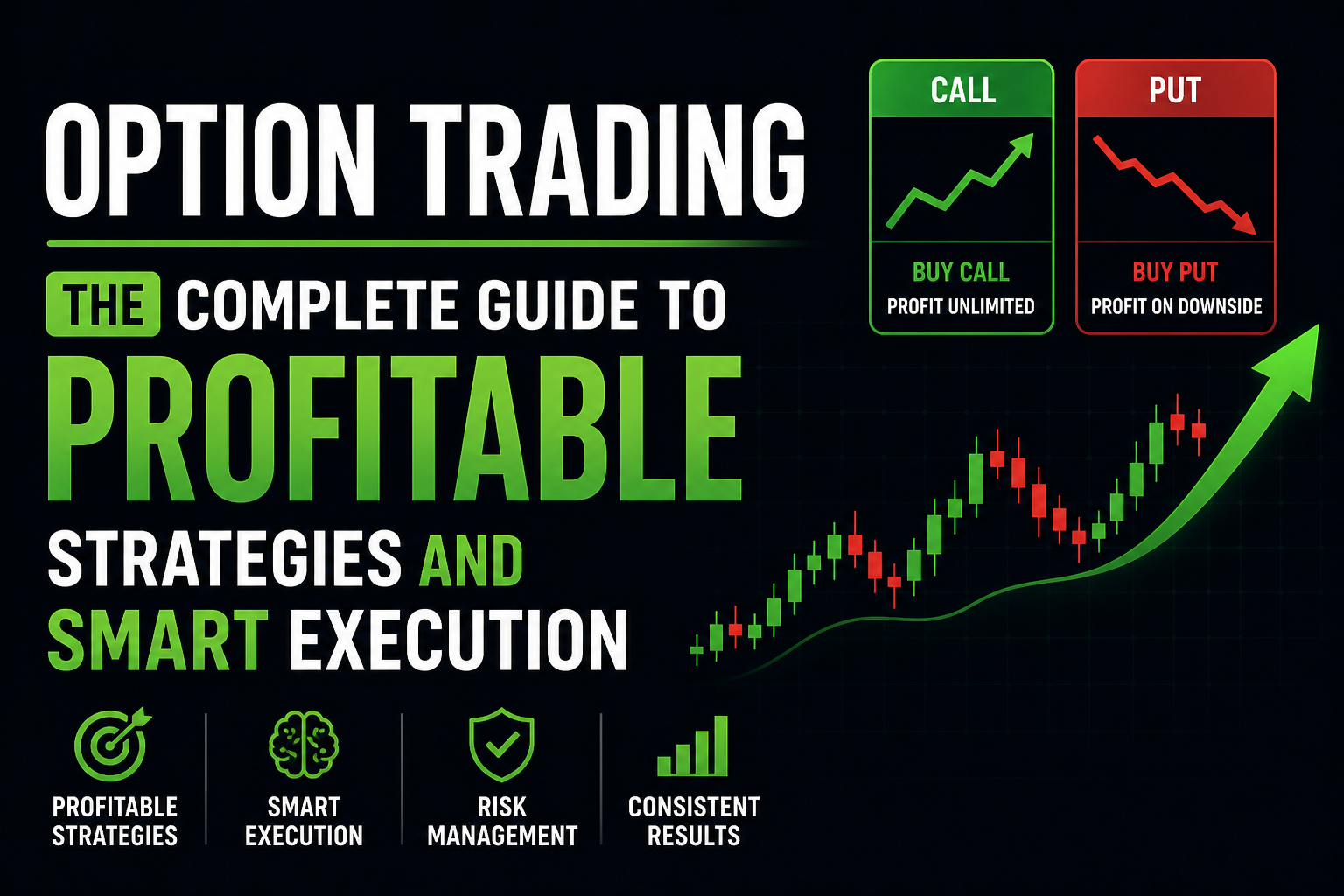
1. Call Options
- Gives the right to buy an asset
- Used when expecting price to rise
2. Put Options
- Gives the right to sell an asset
- Used when expecting price to fall
How Option Trading Works
To succeed in stock and options trading, you must understand how contracts behave.
Key Components:
- Strike Price: Price at which the option can be exercised
- Premium: Cost of the option
- Expiry Date: Last date the option is valid
- Lot Size: Number of units per contract
Step-by-Step: How to Start Option Trading
Step 1: Learn the Basics
Understand call/put options, premiums, and risk.
Step 2: Choose a Broker
Select a platform that supports options share trading with low fees.
Step 3: Analyze the Market
Use technical analysis, trends, and volatility indicators.
Step 4: Select a Strategy
Decide whether to:
- Buy options
- Sell options
- Use spreads
Step 5: Execute the Trade
Place orders based on your analysis.
Step 6: Manage Risk
Always:
- Use stop-loss
- Limit capital exposure
- Avoid over-leverage
Option Trading vs Stock Trading
Comparison (Featured Snippet Section)
| Factor | Option Trading | Stock Trading |
|---|---|---|
| Ownership | No | Yes |
| Risk Level | High | Moderate |
| Capital Required | Lower (leveraged) | Higher |
| Profit Potential | High | Moderate |
| Time Sensitivity | Yes (expiry-based) | No expiry |
Key Insight:
While stock trading relies on price movement alone, option trading allows profit from direction, time decay, and volatility.
Popular Option Trading Strategies
1. Buying Calls (Bullish Strategy)
- Profit when price increases
- Limited risk, unlimited reward
2. Buying Puts (Bearish Strategy)
- Profit when price decreases
3. Covered Call
- Sell calls on owned stocks
- Generates passive income
4. Iron Condor
- Works in sideways markets
- Profits from low volatility
5. Straddle Strategy
- Profits from high volatility
- Used during major events
Option Trading in Real Life: Case Study
A trader uses options fi strategies during earnings season:
- Stock price: 1,000
- Expected big move
Strategy:
- Buy call at 1,000
- Buy put at 1,000
Outcome:
- If price moves sharply in either direction → profit
This shows how trade stocks and options strategies can profit even without predicting direction.
Advanced Concepts in Option Trading
1. Implied Volatility (IV)
- Measures expected price movement
- High IV = expensive options
2. Theta (Time Decay)
- Options lose value over time
- Sellers benefit most
3. Delta
- Measures price sensitivity
Common Mistakes in Option Trading
Avoid these critical errors:
- Trading without understanding Greeks
- Ignoring volatility
- Over-leveraging positions
- Holding options till expiry blindly
Internal Linking Opportunities
- Beginner’s guide to stock market investing
- Advanced technical analysis strategies
- Risk management in trading
- Intraday trading strategies
External Authoritative References
- NSE India (for derivatives data)
- Investopedia (for options education)
- SEBI guidelines on derivatives trading
FAQ Section
1. Is option trading suitable for beginners?
Yes, but only after understanding basic concepts and risk management.
2. How much money is needed to start option trading?
You can start with small capital, but risk management is crucial.
3. What is the safest option trading strategy?
Covered calls and spreads are considered relatively safer.
4. Can option trading make consistent income?
Yes, especially through selling strategies and disciplined execution.
5. What is options fi?
It refers to financial strategies involving options trading instruments.
6. Is option trading risky?
Yes, due to leverage and time decay.
7. How do professionals trade stocks and options?
They use structured strategies, data analysis, and strict risk management.
CONCLUSION
Option trading is a powerful tool that, when used correctly, can significantly enhance your trading performance. It allows flexibility, strategic execution, and multiple ways to profit beyond simple price movement.
However, success in option trading depends on discipline, education, and consistent strategy execution. Whether you are exploring options share trading or planning to trade stocks and options, the key is to approach the market with knowledge and structure.
ON-PAGE SEO ELEMENTS
Meta Title:
Option Trading Guide for Beginners & Pros
Meta Description:
Learn option trading strategies, risks, and execution. Master stock and options trading with this complete beginner-to-advanced guide.
URL Slug:
/option-trading-complete-guide