
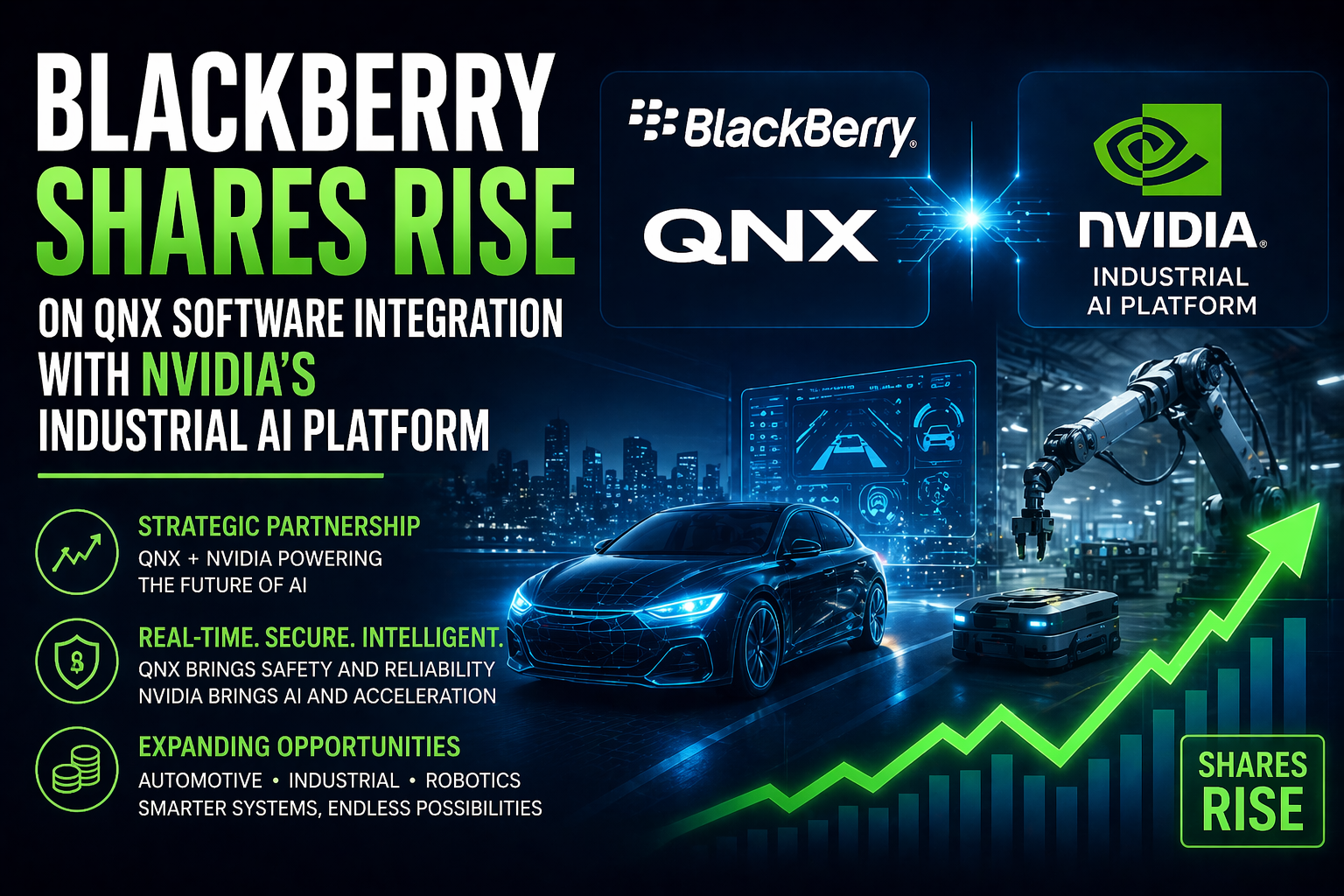
BlackBerry shares rose after announcing the integration of its QNX software with Nvidia’s industrial AI platform because the partnership strengthens its position in automotive and industrial systems, expands revenue opportunities, and signals long-term growth in embedded AI and software-defined vehicles.
Introduction
The market reacted quickly when news broke that BlackBerry’s QNX software is being integrated with Nvidia’s industrial AI platform. Investors saw more than just a partnership—they saw a strategic move that could redefine BlackBerry’s role in the future of intelligent systems.
For years, BlackBerry has been transitioning from a smartphone company to a software-driven enterprise focused on cybersecurity and embedded systems. Now, with Nvidia dominating AI infrastructure, this collaboration places BlackBerry at the center of the next wave of industrial and automotive innovation.
So, why exactly did BlackBerry shares rise, and what does this mean for investors, developers, and the broader AI ecosystem? Let’s break it down.
What Happened: BlackBerry QNX Meets Nvidia Industrial AI
Definition (Featured Snippet)
BlackBerry’s QNX integration with Nvidia’s industrial AI platform refers to the combination of QNX’s real-time operating system with Nvidia’s AI computing infrastructure to enable intelligent, secure, and high-performance systems in automotive, robotics, and industrial applications.
Why BlackBerry Shares Are Rising
1. Strategic Positioning in Industrial AI
The integration signals that BlackBerry is no longer just a cybersecurity company—it’s becoming a core infrastructure player in AI-driven systems.
- Nvidia brings AI processing power
- QNX brings reliability and real-time performance
Together, they create a powerful stack for:
- Autonomous vehicles
- Smart factories
- Robotics systems
Therefore, investors see long-term scalability.
2. Expansion Into Software-Defined Vehicles
One of the biggest growth areas is the automotive industry.
QNX already powers:
- Advanced Driver Assistance Systems (ADAS)
- Infotainment systems
- Digital cockpits
With Nvidia’s AI platform:
- Vehicles become smarter
- Real-time decision-making improves
- Safety systems become more advanced
As a result, BlackBerry strengthens its foothold in the future of mobility.
3. Increased Revenue Potential
This integration opens multiple monetization channels:
- Licensing QNX software
- Subscription-based services
- AI-driven system integrations
Moreover, enterprise clients are willing to pay a premium for secure, AI-enabled infrastructure.
4. Strong Market Sentiment Around AI
The AI sector continues to attract massive investment. Any company aligning with AI leaders like Nvidia benefits from:
- Increased investor confidence
- Higher valuations
- Stronger growth narratives
BlackBerry’s association with Nvidia directly boosts its perception in the market.
Step-by-Step: How This Integration Creates Value
Step 1: QNX provides a real-time OS
QNX ensures:
- Stability
- Security
- Low-latency processing
Step 2: Nvidia Adds AI Capabilities
Nvidia contributes:
- Machine learning models
- GPU acceleration
- AI frameworks
Step 3: Combined Platform Enables Smart Systems
Together, they power:
- Autonomous decision-making
- Predictive analytics
- Edge AI applications
Step 4: Industries Adopt the Technology
Used across:
- Automotive
- Manufacturing
- Healthcare robotics
Step 5: Revenue and Market Value Increase
As adoption grows:
- BlackBerry earns licensing revenue
- Stock value reflects growth potential
Real-World Applications of the Integration
1. Autonomous Vehicles
Cars can:
- Process real-time data
- Make instant driving decisions
- Improve safety and efficiency
2. Smart Manufacturing
Factories can:
- Use AI for predictive maintenance
- Automate production lines
- Reduce operational costs
3. Robotics and Industrial Automation
Robots powered by QNX + Nvidia can:
- Operate with precision
- Adapt to environments
- Improve productivity
Comparison: BlackBerry Before vs After Nvidia Integration
| Factor | Before Integration | After Integration |
|---|---|---|
| Market Perception | Legacy software company | AI-enabled infrastructure player |
| Revenue Streams | Limited growth | Expanded AI-driven opportunities |
| Industry Role | Supportive | Core technology provider |
| Investor Sentiment | Neutral | Strongly positive |
Key Insight:
This partnership shifts BlackBerry from a niche player to a strategic enabler of industrial AI ecosystems.
Strategic Insights: Why This Matters Long-Term
1. AI + Embedded Systems Is the Future
The real growth in AI isn’t just in cloud models—it’s in:
- Edge computing
- Real-time systems
- Embedded intelligence
BlackBerry is now positioned directly in this space.
2. Nvidia’s Ecosystem Advantage
Nvidia is building a full-stack AI ecosystem. Being part of it means:
- Access to global clients
- Faster adoption cycles
- Increased credibility
3. High Switching Costs
Once industries adopt QNX + Nvidia systems:
- Switching becomes difficult
- Long-term contracts increase
- Revenue becomes more predictable
Risks to Consider
While the outlook is strong, there are risks:
- Dependence on Nvidia’s ecosystem
- Competition from other OS platforms
- Execution challenges in scaling
However, the upside currently outweighs the risks in the eyes of investors.
Internal Linking Opportunities
You can link this blog to:
- “How AI Is Transforming the Automotive Industry”
- “What Is Embedded Software and Why It Matters”
- “Top AI Stocks to Watch in 2026”
- “Future of Autonomous Vehicles Explained”
- “Edge Computing vs Cloud Computing”
External References (Suggested)
- Nvidia official announcements on industrial AI
- BlackBerry investor relations updates
- Industry reports from McKinsey or Gartner on AI and automotive tech
FAQ: BlackBerry QNX and Nvidia Integration
Because the integration with Nvidia signals strong growth potential in AI and automotive sectors.
QNX is a real-time operating system used in automotive, industrial, and embedded systems.
Nvidia provides AI processing, machine learning capabilities, and GPU acceleration.
Yes, it strengthens BlackBerry’s position in high-growth AI markets.
Automotive, manufacturing, and robotics see the biggest impact.
It combines real-time OS reliability with advanced AI capabilities.
Yes, it increases competition in AI-driven embedded systems.
Conclusion
The news that BlackBerry shares rise on QNX software integration with Nvidia’s industrial AI platform is more than just a short-term market reaction—it reflects a fundamental shift in how BlackBerry is positioned in the global tech ecosystem.
By combining QNX’s reliability with Nvidia’s AI power, BlackBerry is stepping into a high-growth space where demand is only increasing. This move strengthens its relevance in automotive innovation, industrial automation, and next-generation AI systems.
Strong CTA:
If you’re tracking AI-driven opportunities or emerging tech ecosystems, now is the time to closely watch companies like BlackBerry that are quietly building the backbone of future intelligent systems.