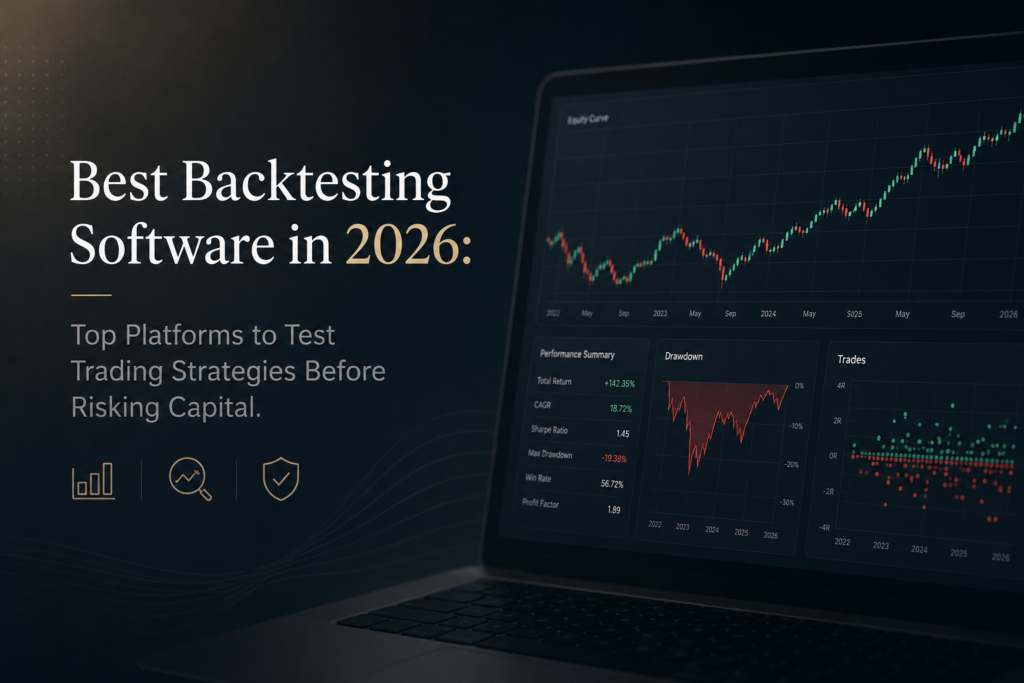

The best AI trading indicators use machine learning, predictive analytics, market sentiment analysis, trend detection, and pattern recognition to identify trading opportunities. To use AI trading indicators effectively, traders should select reliable AI tools, combine them with proven AI trading strategies, validate signals through backtesting, apply risk management, and continuously optimize performance.
Introduction
Artificial Intelligence is rapidly changing the way traders analyze financial markets. Traditional indicators such as moving averages, RSI, MACD, and Bollinger Bands have long been valuable tools, but AI is taking market analysis to an entirely new level.
Unlike conventional indicators that rely on fixed formulas, AI trading indicators can process vast amounts of market data, identify hidden relationships, adapt to changing market conditions, and generate predictive insights. As a result, traders are increasingly incorporating AI-powered tools into their workflows to improve decision-making and gain a competitive edge.
Whether you’re trading stocks, forex, cryptocurrencies, or commodities, understanding how AI trading indicators work can help you identify opportunities more efficiently and potentially improve trading performance.
In this guide, you’ll learn what AI trading indicators are, how they work, the most popular AI-powered indicators available today, and the best AI trading strategies for using them effectively.
What Are AI Trading Indicators?
Definition
AI trading indicators are advanced analytical tools that use artificial intelligence, machine learning, and predictive algorithms to analyze market data and generate trading signals.
Unlike traditional indicators, AI-powered indicators can:
- Learn from historical market data
- Adapt to changing market conditions
- Analyze multiple variables simultaneously
- Identify complex patterns
- Generate predictive forecasts
These capabilities make AI indicators particularly attractive for traders seeking data-driven insights.
How AI Trading Indicators Work
AI indicators combine traditional technical analysis with advanced computational models.
Step 1: Data Collection
The system gathers:
- Price data
- Volume data
- Volatility metrics
- News sentiment
- Economic indicators
- Market structure information
Step 2: Pattern Recognition
Machine learning models identify recurring market behaviors and relationships.
Step 3: Signal Generation
The AI evaluates probabilities and generates buy, sell, or hold signals.
Step 4: Continuous Learning
Some AI systems refine their models as new data becomes available.
Step 5: Performance Optimization
The system adjusts recommendations based on evolving market conditions.
Why Traders Use AI Trading Indicators
Several advantages have made AI indicators increasingly popular.
Enhanced Data Processing
AI can analyze significantly more information than traditional indicators.
Faster Market Analysis
Signals can be generated almost instantly.
Reduced Emotional Bias
AI focuses on objective data rather than psychological reactions.
Predictive Capabilities
Many AI systems attempt to forecast future market behavior rather than simply describe current conditions.
Improved Adaptability
AI models can adjust to changing market environments more effectively than fixed-rule indicators.
The Most Popular AI Trading Indicators
1. AI Trend Prediction Indicators
These indicators identify emerging trends before they become obvious.
What They Analyze
- Price momentum
- Volume changes
- Volatility patterns
- Market sentiment
Best For
- Trend traders
- Swing traders
- Position traders
2. AI Sentiment Indicators
Market sentiment often drives short-term price movements.
AI sentiment indicators analyze:
- News articles
- Social media discussions
- Analyst reports
- Financial publications
Best For
- Forex traders
- Stock traders
- Cryptocurrency investors
3. Machine Learning Forecast Indicators
These indicators use historical data to estimate future price probabilities.
Common Applications
- Price forecasting
- Volatility forecasting
- Trend prediction
Best For
Data-driven trading approaches.
4. AI Pattern Recognition Indicators
Pattern recognition systems automatically identify chart formations.
Examples include:
- Head and shoulders
- Double tops
- Triangles
- Flags
- Breakouts
Best For
Technical traders seeking automation.
5. AI Support and Resistance Indicators
AI systems dynamically identify key support and resistance zones based on evolving market conditions.
Benefits
- Improved accuracy
- Reduced subjectivity
- Real-time adjustments
AI Trading Indicators vs Traditional Indicators
| Feature | AI Trading Indicators | Traditional Indicators |
|---|---|---|
| Adaptability | High | Low |
| Data Processing | Extensive | Limited |
| Learning Capability | Yes | No |
| Predictive Analysis | Often | Rarely |
| Complexity | High | Moderate |
| Automation Potential | Excellent | Moderate |
AI indicators offer significant advantages, although they often require more sophisticated implementation and oversight.
Best AI Trading Strategies
The effectiveness of AI indicators depends largely on how they are incorporated into broader trading systems.
1. AI Trend-Following Strategy
This approach uses AI to identify strong directional trends.
Entry Rules
- AI confirms trend strength
- Volume supports movement
- Momentum indicators align
Exit Rules
- Trend reversal signals
- Risk limits reached
2. AI Mean Reversion Strategy
AI identifies assets that have deviated significantly from historical norms.
Suitable Markets
- Range-bound markets
- Stable assets
- Low-volatility environments
3. AI Breakout Strategy
AI detects potential breakout setups before significant price movement occurs.
Benefits
- Early opportunity identification
- Improved entry timing
4. AI Sentiment Trading Strategy
This strategy combines sentiment analysis with technical confirmation.
Data Sources
- Financial news
- Social media
- Analyst commentary
5. AI Scalping Strategy
AI systems analyze micro price movements and execute trades rapidly.
Best For
- Forex trading
- Cryptocurrency trading
- High-liquidity markets
How to Use AI Trading Indicators Effectively
Step 1: Select a Reliable AI Tool
Choose indicators with:
- Transparent methodology
- Strong performance history
- Reliable data sources
Step 2: Understand the Logic
Never use an indicator you don’t fully understand.
Step 3: Backtest Signals
Validate performance across multiple market environments.
Step 4: Combine Indicators
Avoid relying on a single signal source.
Step 5: Implement Risk Management
Use:
- Stop-loss orders
- Position sizing rules
- Portfolio diversification
Step 6: Monitor Performance
Track results and adjust when necessary.
Real-World Example of AI Trading Indicators
Imagine a trader using an AI-powered trend prediction system.
The indicator:
- Analyzes price action.
- Evaluates market sentiment.
- Detects increasing volume.
- Generates a bullish signal.
- Confirms the trend through machine learning analysis.
The trader enters the position only after additional technical confirmation.
This combination of AI and human oversight often produces stronger decision-making.
Benefits of AI Trading Indicators
Faster Analysis
Markets can be evaluated in real time.
Better Pattern Recognition
AI identifies opportunities that humans may overlook.
Improved Efficiency
Automation reduces manual workload.
Enhanced Decision-Making
Data-driven insights support more objective trading.
Scalability
Multiple assets can be analyzed simultaneously.
Limitations of AI Trading Indicators
No Guarantee of Success
AI cannot predict markets with complete accuracy.
Data Dependence
Poor-quality data leads to poor signals.
Market Regime Changes
Historical relationships may break down.
Overfitting Risk
Some models perform well in testing but fail in live markets.
Technical Complexity
Advanced systems often require ongoing maintenance.
Internal Linking Opportunities
Consider linking this article to:
- Learn Algorithmic Trading
- Best Trading Bot Strategies
- How to Build a Trading Bot
- Artificial Intelligence in Forex Trading
- Technical Analysis for Beginners
External Authoritative References
For additional research, consider:
FAQ
What are AI trading indicators?
AI trading indicators are analytical tools that use artificial intelligence and machine learning to analyze market data and generate trading signals.
Are AI trading indicators accurate?
AI indicators can improve analysis and signal generation, but no indicator can guarantee profitable trades.
What are the best AI trading strategies?
Popular AI trading strategies include trend following, mean reversion, breakout trading, sentiment analysis, and AI-assisted scalping.
Can beginners use AI trading indicators?
Yes. Many modern trading platforms provide beginner-friendly AI tools and automated insights.
Do AI trading indicators replace technical analysis?
Not entirely. Many traders combine AI indicators with traditional technical analysis for stronger confirmation.
Are AI trading indicators useful for forex trading?
Yes. AI indicators are widely used in forex markets for trend analysis, sentiment evaluation, and signal generation.
Can AI indicators predict market movements?
AI systems attempt to forecast probabilities based on historical and real-time data, but predictions are never guaranteed.
Conclusion
AI is transforming financial market analysis by providing traders with more sophisticated tools for identifying opportunities and managing risk. The best AI trading indicators combine machine learning, predictive analytics, and real-time data processing to deliver insights that traditional indicators may miss.
However, successful trading still requires discipline, risk management, and strategic thinking. The most effective traders use AI as an enhancement rather than a replacement for sound decision-making. By combining reliable AI trading indicators with proven AI trading strategies, traders can build more efficient, data-driven approaches to navigating today’s increasingly complex financial markets.
If you’re looking to improve your trading process, start by testing AI-powered indicators, validating their performance through backtesting, and gradually integrating them into your overall trading strategy.
Meta Title
AI Trading Indicators: Best AI Trading Strategies Guide
Meta Description
Discover the best AI trading indicators, learn how AI trading strategies work, and explore machine learning tools for smarter market analysis.
URL Slug
ai-trading-indicators