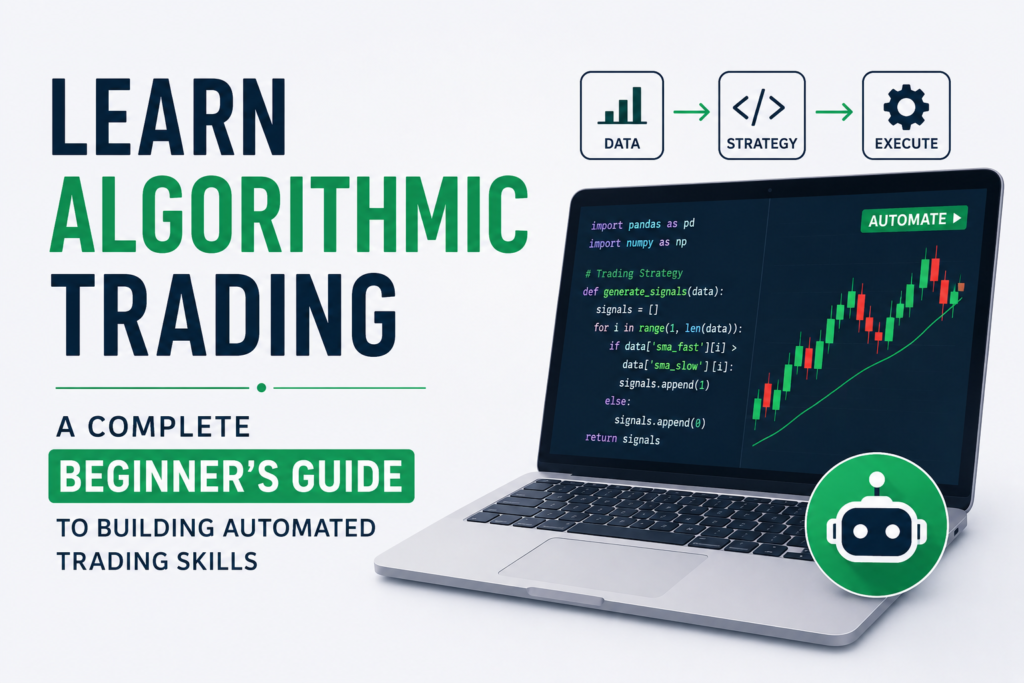

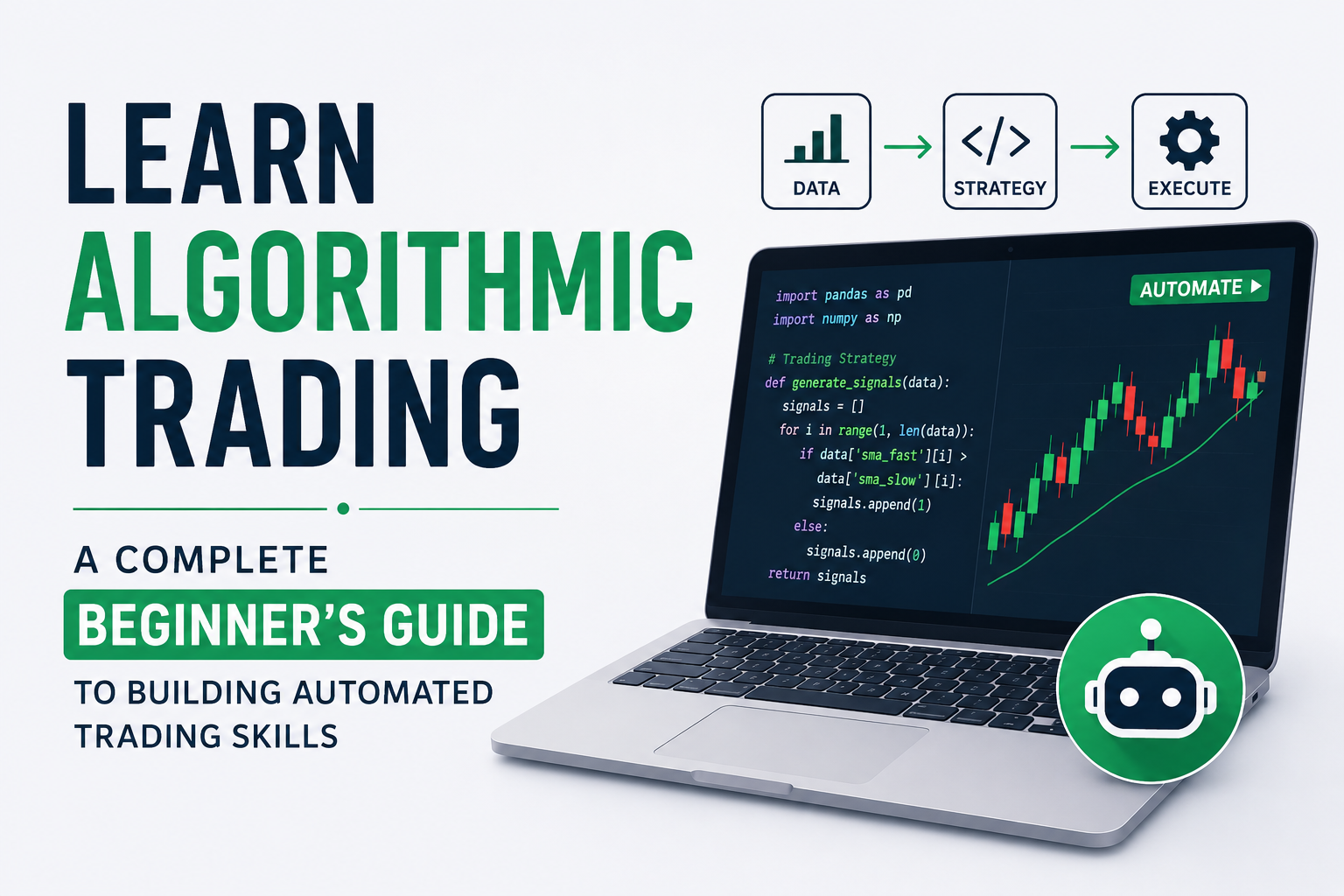
If you want to learn algorithmic trading, start by understanding financial markets, trading strategies, programming fundamentals, and data analysis. Algorithmic trading involves using computer programs to automatically execute trades based on predefined rules. For beginners, the most effective path includes learning market concepts, mastering a programming language like Python, testing trading strategies, understanding risk management, and gradually building automated systems that can operate with minimal human intervention.
Introduction
The financial markets have undergone a massive transformation over the last two decades. What was once dominated by manual traders making decisions based on charts and intuition is now increasingly driven by algorithms capable of analyzing vast amounts of data and executing trades in milliseconds.
Today, algorithmic trading powers a significant portion of global market activity. Hedge funds, investment banks, proprietary trading firms, and even individual traders use automated systems to identify opportunities and execute trades more efficiently than humans ever could.
As a result, more aspiring traders are looking to learn algorithmic trading and develop skills that combine finance, technology, mathematics, and data science.
The good news is that becoming an algorithmic trader is more accessible than ever. With modern programming tools, online learning resources, and cloud computing platforms, beginners can build and test trading algorithms without needing institutional-level infrastructure.
In this guide, you’ll learn what algorithmic trading is, how automated trading works, the skills required to succeed, and a step-by-step roadmap for becoming an algorithmic trader.
What Is Algorithmic Trading?
Definition
Algorithmic trading is the process of using computer programs to automatically execute trades based on predefined rules, mathematical models, or market conditions.
These rules can be based on:
- Price movements
- Technical indicators
- Statistical models
- Market trends
- Volume patterns
- Risk management parameters
Once programmed, the algorithm continuously monitors the market and executes trades when specific conditions are met.
Unlike discretionary trading, algorithmic trading removes much of the emotional decision-making that often leads to costly mistakes.
Why More Traders Are Learning Algorithmic Trading
The popularity of algorithmic trading continues to grow because it offers several significant advantages.
Faster Execution
Algorithms can analyze market conditions and place orders within milliseconds.
Elimination of Emotional Bias
Fear and greed frequently influence manual traders.
Automated systems follow predefined rules consistently.
Scalability
Algorithms can monitor hundreds or even thousands of securities simultaneously.
Data-Driven Decisions
Trading decisions are based on objective market data rather than opinions or emotions.
24/7 Market Monitoring
This is particularly valuable for cryptocurrency and global financial markets.
How Automated Trading Works
Understanding the workflow behind automated trading for beginners is essential before building your first strategy.
Step 1: Market Data Collection
The algorithm gathers information such as:
- Price data
- Volume data
- Technical indicators
- Market news
- Historical datasets
Step 2: Signal Generation
The system analyzes incoming data and identifies potential opportunities.
Step 3: Trade Execution
When predefined conditions are satisfied, the algorithm automatically places orders.
Step 4: Risk Management
The system applies:
- Stop-loss orders
- Position sizing rules
- Portfolio limits
- Profit targets
Step 5: Performance Monitoring
Results are continuously evaluated and optimized.
Skills You Need to Learn Algorithmic Trading
Many beginners assume algorithmic trading is purely about coding.
In reality, successful algorithmic traders combine multiple disciplines.
Financial Market Knowledge
Understanding how markets function is the foundation.
Key topics include:
- Market structure
- Asset classes
- Trading psychology
- Technical analysis
- Fundamental analysis
Programming Skills
Programming is one of the most important skills required.
Recommended Languages
- Python
- R
- C++
- Java
For most beginners, Python is the preferred starting point due to its simplicity and extensive financial libraries.
Data Analysis
Algorithmic trading depends heavily on data.
Important concepts include:
- Data cleaning
- Statistical analysis
- Data visualization
- Machine learning fundamentals
Risk Management
Even the most sophisticated algorithms can fail without proper risk controls.
Quantitative Thinking
Strong problem-solving and analytical skills help traders develop and evaluate trading models effectively.
How to Become an Algorithmic Trader
Many aspiring traders ask: How to become an algorithmic trader?
The journey typically follows a structured progression.
Step 1: Learn Market Fundamentals
Begin by understanding:
- Stocks
- Forex
- Cryptocurrencies
- Commodities
- Market mechanics
Without market knowledge, coding skills alone won’t create profitable systems.
Step 2: Learn Python
Python has become the industry standard for retail algorithmic trading.
Focus on:
- Variables
- Functions
- Data structures
- APIs
- Data analysis libraries
Popular libraries include:
- Pandas
- NumPy
- Matplotlib
- Scikit-learn
Step 3: Study Trading Strategies
Learn how common strategies work.
Examples include:
- Trend following
- Mean reversion
- Momentum trading
- Pair trading
- Breakout trading
Step 4: Backtest Strategies
Backtesting evaluates how a strategy would have performed historically.
Benefits include:
- Performance validation
- Risk assessment
- Optimization opportunities
Step 5: Paper Trade
Before risking real money, test your algorithm in simulated market conditions.
Step 6: Deploy Live
Start with small position sizes and gradually increase exposure as confidence grows.
Best Algorithmic Trading Strategies for Beginners
Moving Average Crossover
One of the simplest strategies.
Buy Signal
Short-term moving average crosses above long-term moving average.
Sell Signal
Short-term moving average crosses below long-term moving average.
Mean Reversion Strategy
Assumes prices eventually return to their historical average.
Momentum Trading
Focuses on assets exhibiting strong directional movement.
Breakout Trading
Enters trades when price moves beyond key support or resistance levels.
Dollar-Cost Averaging Automation
Automatically invests fixed amounts at predetermined intervals.
This approach is often ideal for automated trading for beginners.
Algorithmic Trading vs Manual Trading
| Feature | Algorithmic Trading | Manual Trading |
|---|---|---|
| Speed | Extremely Fast | Slower |
| Emotional Bias | Minimal | High |
| Scalability | Excellent | Limited |
| Consistency | High | Variable |
| Market Monitoring | Continuous | Limited |
| Decision Making | Rule-Based | Discretionary |
While algorithms offer significant advantages, human oversight remains important.
Common Mistakes New Algorithmic Traders Make
Overcomplicating Strategies
Many beginners create unnecessarily complex systems.
Simple strategies often perform better.
Overfitting Historical Data
A strategy may appear successful in backtesting but fail in live markets.
Ignoring Risk Management
No algorithm can guarantee profits.
Risk controls remain essential.
Unrealistic Expectations
Algorithmic trading is not a shortcut to instant wealth.
Successful traders focus on long-term consistency.
Neglecting Market Conditions
Markets evolve, and algorithms must adapt accordingly.
Real-World Example of Algorithmic Trading
Imagine a trader developing a simple moving average strategy.
The algorithm:
- Monitors a stock’s 50-day and 200-day moving averages.
- Generates a buy signal when the 50-day average crosses above the 200-day average.
- Applies a stop-loss at 5%.
- Exits when the trend reverses.
The system executes these rules automatically without emotional interference.
This illustrates how algorithmic trading transforms a trading idea into a repeatable process.
The Future of Algorithmic Trading
The industry continues to evolve rapidly.
Emerging technologies include:
Artificial Intelligence
AI-driven systems can adapt to changing market conditions.
Machine Learning
Algorithms learn from historical and real-time data.
Alternative Data Sources
Modern systems increasingly analyze:
- Social media sentiment
- News feeds
- Satellite imagery
- Blockchain data
Cloud Computing
Cloud infrastructure enables faster analysis and scalability.
As these technologies mature, opportunities for individual algorithmic traders are expected to expand.
Internal Linking Opportunities
Consider linking this article to:
- Beginner’s Guide to Stock Trading
- Best Trading Strategies for Beginners
- Python for Finance and Trading
- Risk Management Techniques for Traders
- Backtesting Trading Strategies Explained
External Authoritative References
For additional learning, consider referencing:
FAQ
What is algorithmic trading?
Algorithmic trading uses computer programs to automatically execute trades based on predefined rules and market conditions.
Can beginners learn algorithmic trading?
Yes. With the availability of online resources and programming tools, beginners can gradually learn algorithmic trading and develop automated systems.
What programming language is best for algorithmic trading?
Python is widely considered the best language for beginners due to its simplicity and extensive ecosystem of financial libraries.
How long does it take to become an algorithmic trader?
The timeline varies, but most beginners require several months to develop foundational skills and build their first trading systems.
Is algorithmic trading profitable?
Algorithmic trading can be profitable when supported by robust strategies, proper testing, and disciplined risk management.
Do I need a finance degree to learn algorithmic trading?
No. While financial knowledge is beneficial, many successful algorithmic traders come from technology, engineering, and mathematics backgrounds.
What is the easiest automated trading strategy for beginners?
Moving average crossover and dollar-cost averaging strategies are often considered beginner-friendly starting points.
Conclusion
Learning algorithmic trading is one of the most valuable investments aspiring traders can make in today’s increasingly technology-driven financial markets. By combining market knowledge, programming skills, data analysis, and risk management, traders can build automated systems capable of identifying opportunities and executing trades efficiently.
For those wondering how to become an algorithmic trader, the path begins with understanding market fundamentals, learning Python, studying proven trading strategies, and gradually developing real-world experience through testing and deployment. While success requires patience and continuous learning, the rewards can be substantial for traders willing to invest in their skills.
If you’re ready to enter the future of trading, start learning algorithmic trading today, build your first strategy, and take the first step toward creating data-driven, automated trading systems that can scale with your ambitions.